Kurdish Farmers Face Trial in Kirkuk Amid Ongoing Land Dispute Controversy
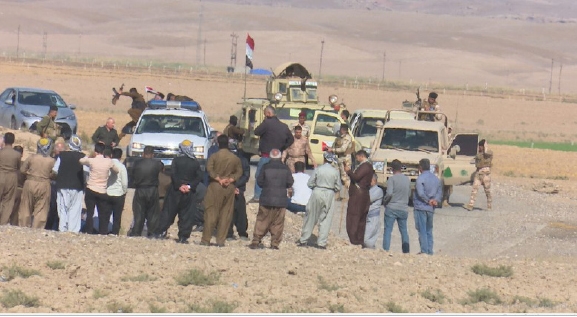
Three Kurdish farmers are scheduled to stand trial on Sunday in the disputed province of Kirkuk, a case that underscores the persistent and volatile tensions over land ownership dating back to the Baathist era.
The trials stem from separate complaints filed by the Iraqi military and Arab settlers, according to a representative for the farmers.
Mohammed Amin, the head of the farmers’ defense committee in Kirkuk’s northwestern Sargaran district, is one of the defendants. He told Rudaw that he will be tried in a court in the Dibis district following a complaint from the Joint Operations Command related to a confrontation with Iraqi soldiers on February 17.
During the incident, Amin was pulled from his tractor by his scarf. He initially filed a complaint against the soldier involved, who was briefly detained and released. In response, the Iraqi Defense Ministry and the soldier filed separate lawsuits against him, leading to charges of “sabotage and rioting.”
“The soldiers tried to pull me down from my tractor and assault me forcefully, and now they want to punish me through court,” Amin lamented.
Two other Kurdish farmers will also face trial after complaints were filed against them by Arab settlers, Amin stated.
Background of the Land Dispute
The trials are set against a decades-old backdrop of forced demographic change. In 1975, the Iraqi government declared several Kurdish villages in Kirkuk prohibited oil zones, stripping residents of their land rights. By 1977, through Baath Supreme Revolutionary Court Decree No. 949, those lands were redistributed to Arab settlers from other parts of Iraq in a process known as "Arabization."
After the fall of Saddam Hussein’s regime in 2003, Iraq’s constitution included Article 140, which was designed to reverse these demographic changes. However, its implementation has been stalled for over two decades.
In a significant move this January, Iraq’s parliament passed a landmark land restitution law to return property confiscated from Kurds and Turkmen during the Baath era. The legislation, ratified by the presidency in February, covers approximately 300,000 dunams (around 750 square kilometers) in Kirkuk and other disputed areas.
Championed by Kurdish and Turkmen parties, the law was intended to begin correcting decades of engineered demographic change.
In March, the Justice Ministry announced the formation of a specialized committee to oversee the law’s implementation and suspended all land dealings in Kirkuk. Justice Minister Khalid Shwani stated that enforcement would begin within two months.
Yet, farmers on the ground report no progress. The urgency of the situation was highlighted just this Monday when two Kurdish farmers were rearrested in northwestern Kirkuk after Arab settlers accused them of illegally using the contested land.