SpaceX’s Starship Aims for Mars Mission by 2026, Carrying Tesla’s Optimus Robot
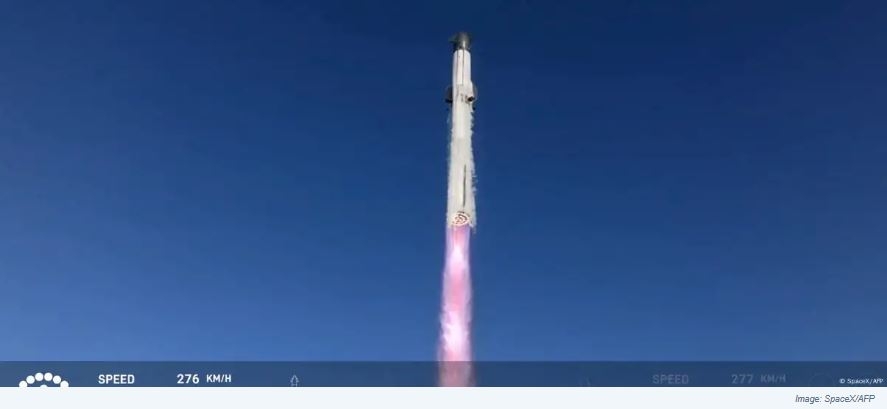
SpaceX founder Elon Musk announced on Friday that the company’s massive Starship rocket is set to embark on a mission to Mars by the end of 2026, with Tesla’s humanoid robot, Optimus, on board. In a post on X, Musk also hinted that human landings on Mars could begin as early as 2029, though 2031 is a more likely target. This update comes amid recent setbacks for SpaceX and Musk’s ambitious vision of colonizing the Red Planet.
What is Starship?
Starship, the largest and most powerful rocket ever built, stands at 403 feet (123 meters) tall—about 100 feet taller than the Statue of Liberty. Designed for deep space exploration, the fully reusable rocket is central to Musk’s plan to establish a human colony on Mars. SpaceX envisions Starship as a vehicle for cost-effective and efficient missions to the Moon, Mars, and beyond.
NASA is also relying on a modified version of Starship as a lunar lander for its Artemis program, which aims to return astronauts to the Moon by the end of this decade. However, before these missions can proceed, SpaceX must demonstrate that Starship is reliable, safe, and capable of complex in-orbit refueling—a critical requirement for deep space travel.
Recent Challenges and Progress
Starship has undergone multiple test flights, with mixed results. While some tests have ended in fiery explosions, including two failures this year, the program has also achieved milestones, such as reaching space. Despite these setbacks, SpaceX’s “fail fast, learn fast” approach has solidified its position as the world’s leading launch services provider.
Tesla’s Optimus Robot on Board
The Mars mission will also carry Tesla’s humanoid robot, Optimus, also known as Tesla Bot. Designed to perform repetitive, dangerous, or mundane tasks, Optimus was unveiled last year with an expected retail price of 20,000to20,000to30,000. Its inclusion in the Mars mission underscores Musk’s vision of integrating advanced robotics into space exploration and colonization efforts.
Starship departs for Mars at the end of next year, carrying Optimus.
— Elon Musk (@elonmusk) March 15, 2025
If those landings go well, then human landings may start as soon as 2029, although 2031 is more likely. https://t.co/JRBB95sgNN
Political and Regulatory Hurdles
Musk’s Mars ambitions have also intersected with politics. In November, Reuters reported that Musk’s goal of transporting humans to Mars could gain greater national priority under former U.S. President Donald Trump. Sources indicated that Musk’s push for reforms at the Federal Aviation Administration (FAA), which regulates SpaceX, could accelerate progress toward Mars.
However, Musk’s close ties to Trump and his influence over federal regulators have raised concerns about potential conflicts of interest. Musk has frequently clashed with the FAA, accusing it of over-regulating SpaceX and delaying Starship’s development. Trump’s 2017 inauguration speech, in which he vowed to “plant the Stars and Stripes on Mars,” further highlighted the alignment between Musk’s goals and Trump’s space policy.
Criticism and Controversy
Musk’s alignment with Trump, coupled with accusations of interference in European politics, has made him a target of criticism and legal scrutiny. Critics argue that his political connections and influence could create conflicts of interest for SpaceX and his other ventures.
Despite these challenges, Musk remains steadfast in his vision. The planned 2026 Mars mission represents a significant step toward making interplanetary colonization a reality, though the road ahead is fraught with technical, regulatory, and political obstacles.
As SpaceX continues to push the boundaries of space exploration, the world will be watching to see if Starship—and Optimus—can help humanity take its first steps toward becoming a multi-planetary species.