Yezidi Cultural Heritage Celebrated as Annual Tawus Tour Embarks on Sacred Journey
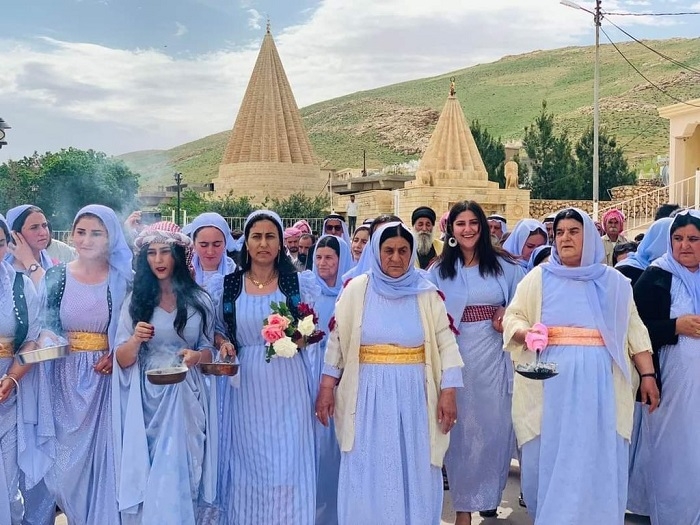
The annual Tawus Tour, locally known as "Gara Tawus," has commenced its revered pilgrimage, traversing the villages and communities of the Yezidis in Duhok province, culminating in the district of Ba’adre. This esteemed tradition not only fortifies social bonds among the Yezidi Kurds but also rekindles the vibrant tapestry of their cultural and religious heritage.
In the Ba'adre subdistrict, a part of the Sheikhan district, residents, resplendent in traditional white Yezidi attire, warmly welcomed the peacock symbol with reverence, employing pans, incense, tambourines, and religious melodies. Khalid Narmo, an esteemed intellectual from Ba’adre, underscored the significance of this event, noting that the "Gara Tawus" traverses all villages and communities in Duhok province and the Nineveh plain, concluding its journey in Ba’adre. He emphasized that this religious tradition, spanning over 1,000 years, has been instrumental in fostering social cohesion within the Yezidi community.
A Symbol of Unity and Tranquility
The Tawus Tour transcends mere religious observance; it represents a convergence of villagers and their kin, fostering a spirit of mutual acceptance and tolerance. Daye Fato, expressing delight at the return of the Tawus, remarked, “We were very pleased with the arrival of the Tawus as it had been absent for several years. When Tawus visits each village, everyone gathers in the evening to share a meal.” This biannual tradition is deeply ingrained in Yezidi culture, wherein a copper Tawus, symbolizing a peacock, is revered as a sacred emblem.
According to Yezidi belief, God dispatched Angel Tawus to enrich the Earth with color, rendering Tawus a symbol of holiness. The Tawus Tour serves a dual purpose: elucidating religious texts and providing guidance while addressing social concerns within the community.
Historical Significance and Sacred Rites
The history of the Tawus Tour is emblematic of resilience. During the Ottoman Empire’s reign over Mosul, Yezidis safeguarded seven Tawuses. However, a genocidal campaign in 1892 resulted in the loss of several sacred artifacts, including Tawuses. Presently, only three of the original seven Tawuses remain, each embarking on distinct tours across various regions. These encompass the “Tawus of Anzal,” the “Tawus of Sinjar,” and the “Tawus of Halab (Aleppo Tawus),” encompassing areas in Iraq and Syria.
Falah Haider Kheder, a devoted Yezidi, expounded on the intricacies of the Tawus Tour, elucidating the roles of various religious figures and the meticulous rituals involved. Out of the three Tawuses that were recovered, one is recognized as the “Tawus of Anzal,” undertaking tours to Yezidi towns and villages in Sheikhan, Tel Kef, Duhok, Bashiqa, and Bahzani. The second, known as the “Tawus of Sinjar,” embarks on tours to Sinjar and Yezidi locales in Sinjar, Haweri (Ezidi tribe) villages, and towns around Zakho. The third, termed Tawus of Halab (Aleppo Tawus), tours Yezidi locales in Syria.
A Communal Affair
Each village eagerly anticipates the arrival of the Tawus. A family is selected to host the sacred symbol, and residents, attired in pristine white garments, assemble to extend their welcome. The Qawals, religious leaders, accompany the event, playing tambourines and flutes as villagers approach to venerate the Tawus, offer prayers, and express wishes. The ceremony encompasses communal feasts, religious recitations, and social deliberations, often resolving local matters.
The Tawus Tour stands as a profound expression of Yezidi faith and culture, emphasizing the importance of unity, guidance, and social harmony. As it traverses Yezidi villages, it not only preserves ancient traditions but also strengthens the communal bonds that constitute the bedrock of Yezidi society.