If the countries of the West work together we can stop Iran’s murder squads
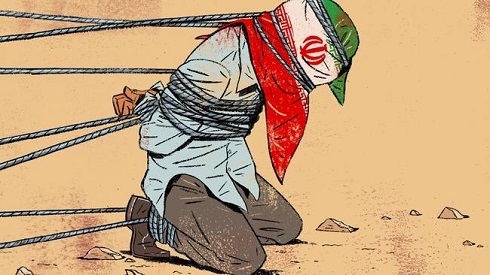
Jamshid Sharmahd, a California-based Iranian opposition activist, disappeared in late July while travelling to a technology conference in India by way of Dubai. His family tracked his movements using mobile phone data to a remote region of neighbouring Oman before he dropped off the map. Days later, he appeared blindfolded on Iranian state television as a result of what the Islamic Republic termed a “complex operation” by “anonymous soldiers”.
More frightening than the apparent kidnapping of the US-based dissident is the fate that likely awaits him. This northern summer Tehran sentenced to death another kidnapped opponent who had been living as a refugee in France. And in recent weeks a prominent Iranian women’s rights activist based in the US revealed that her family had been pressured to invite her to a get-together in neighbouring Turkey so she could be abducted.
Iranian democracy activists living in Western countries are understandably alarmed by this apparent uptick in kidnappings and hope their adopted democratic homes will protect them. But safeguarding these dissidents will require world leaders to stop thinking of such incidents as isolated crimes, and instead confront them as state-sanctioned intimidation policy.
Iran’s leaders have been hunting and killing their opponents since the Islamic Republic was established in 1979. During a reign of terror in the early 1980s the regime executed thousands, including former members of the Iranian parliament, leaders of the country’s Jewish community and Iran’s first female minister. When dissidents fled into exile, government assassins followed. On direct orders from the regime, Captain Shahriar Shafiq and General Ali Gholam Oveissi, former imperial military officers who were leading active opposition groups, were assassinated in Paris in 1979 and 1984, respectively. The former Iranian embassy press attache was shot and killed in the doorway of his Maryland, home in July 1980.
When Ali Khamenei became supreme leader in 1989, an entity under his direct authority known as the special affairs committee began to recommend individual assassinations. The victims included former prime minister Shahpour Bakhtiar, suffocated and stabbed to death in Paris in August 1991, and outspoken singer and activist Fereydoun Farrokhzad, stabbed repeatedly in Bonn in August 1992. The next month, several Kurdish dissidents were gunned down at Berlin’s Mykonos restaurant.
This vast, co-ordinated campaign continues today. In 2017 the head of a popular television station that beamed banned content into Iran was assassinated in an Istanbul street. In 2018 French police foiled an attempted bombing of a large opposition gathering. And late last year a former defence ministry cybersecurity expert who had escaped to Istanbul was shot dead.
Iranian journalists working at foreign-based news outlets have faced repeated threats on their lives and those to their families inside Iran. Other outspoken activists have reported that regime officials have approached family members in Iran to lure them to nearby countries where they can be more easily abducted.
Strategy of kidnap and killing
Many of the assassins and their collaborators are closely allied with the regime’s so-called moderates. Activists, dissidents and opposition leaders living in exile represent a mounting threat to the regime as it faces financial pressure and political unrest at home. In response, Tehran has turned again to a strategy of kidnapping and killing.
Experience shows that Tehran is willing to halt its extraterritorial thuggery only when the costs of its actions outweigh the benefits.
After the Mykonos restaurant bloodbath, Germany’s chief federal prosecutor implicated Iran’s ministry of intelligence in the crime. In 1997, the judge presiding over the gunmen’s trial concluded that top regime officials on the committee for special operations in Tehran had ordered the killings.
Almost immediately, EU member nations withdrew their ambassadors to Iran and cut off diplomatic ties. Although the rebuke was temporary, the regime recoiled and there was a long lull in its assassination campaign.
Western governments will be able to protect dissidents, often full citizens of their adopted countries, only by forcing Iran’s leaders to pay for their crimes. Toothless statements won’t be enough.
As long as Iranian officials freely can roam European capitals, they will know there is no price to pay for killing dissidents — and Iranians abroad such as Sharmahd will continue to live in fear of the assassin’s bullet and the kidnapper’s trap.
The Wall Street Journal
Cameron Khansarinia is policy director for the Washington-based National Union for Democracy in Iran. Kaveh Shahrooz is a lawyer and a senior fellow at the Ottawa-based Macdonald-Laurier Institute.