Israeli president invites UAE crown prince after landmark accord
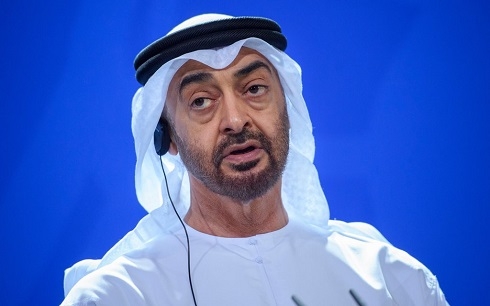
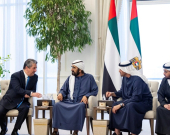
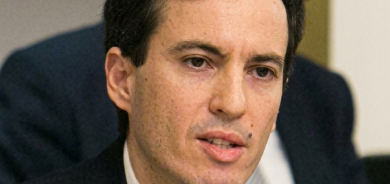
Posting a picture of the invitation letter in Arabic on Twitter, Israel's president hailed the deal taking shape as a "noble and courageous act" and a "strategic milestone," which he hoped would build prosperity and confidence between the peoples of the region.
"Your highness, in these fateful days, leadership is measured by courage and an ability to be groundbreaking and far-sighted," he wrote to bin Zayed.
"I have no doubt that future generations will appreciate the way you, the brave and wise leaders, have restarted the discourse on peace."
Israeli Prime Minister Benjamin Netanyahu earlier announced that the two sides were working to establish direct flights between Tel Aviv and the UAE capital of Abu Dhabi over Saudi Arabia.
That would reduce flight times to three hours.
Israel has historically avoided flying over Saudi airspace, and Israeli airlines have had to make detours via the Gulf to reach destinations in Asia.
Direct flights between Tel Aviv and Abu Dhabi would "tremendously" boost tourism, business investments, trade and aviation, Netanyahu told reporters while touring Israel's Ben Gurion International Airport.
The deal announced last week by Netanyahu, bin Zayed and US President Donald Trump sent shock waves through the region.
While many welcomed it as "historic," others decried it as a stab in the back for Palestinians, and a break from the 2002 Arab peace initiative, which conditioned normalizing ties between Israel and the Arab world on Israeli recognition of a Palestinian state.
A beaming Netanyahu presented it as his personal achievement to the Israeli public during prime time on Thursday.
Palestinians are furious that the UAE conditioned normalizing ties with Israel only on Israel suspending plans to annex parts of the occupied West Bank, and not on Israeli recognition of an independent Palestinian state with East Jerusalem as its capital.
On Monday, a top Islamic religious figure said that a religious decree he issued in 2012 meant UAE nationals were banned from entering Jerusalem's al-Aqsa Mosque.
The grand mufti of Jerusalem and the Palestinian Authority, Sheikh Mohammed Hussein, said his 2012 religious ruling meant that as per religious law, UAE nationals would not be permitted to worship at al-Aqsa, despite the recent deal.
"In 2012 there was a fatwa [religious decree] allowing visits to Jerusalem and al-Aqsa within certain criteria, and normalization was not one of them," the mufti told dpa.
"Since this agreement has normalization signs, visiting Jerusalem is not permissible and forbidden," he said.
Netanyahu is also receiving pushback from some Israelis. Furious settlers have accused him of breaking his election promise to extend Israeli sovereignty over West Bank settlements.
An official close to Netanyahu's leading coalition partner, Defence Minister Benny Gantz, said on Monday it was unheard of that Gantz had been kept in the dark about the deal until the last minute.
The UAE's move comes after rapprochement between Israel and several Gulf states, including Oman, which Netanyahu visited in 2018 despite not having official diplomatic ties.
On Monday, Oman's top diplomat Youssef bin Alawi received a phone call from his Israeli counterpart Gabi Ashkenazi. They discussed "the latest developments," Oman's Foreign Ministry said.
The sultanate stressed its "firm and supportive position to achieve a comprehensive, just and lasting peace in the Middle East, and the need to resume peace negotiations and fulfil the legitimate demands of the Palestinian people to establish an independent state with East Jerusalem as its capital."
Bin Alawi also spoke with Jibril Rajoub, a senior Fatah official, the ministry added.
Israel's Foreign Ministry also stated that the phone conversation with bin Alawi had taken place, and that the latter had underlined his support for "just and lasting peace in the Middle East."
They plan to maintain direct contact, Israel's ministry said, noting that they had last spoken together two months ago.