Climate activist Greta Thunberg wins 'alternative Nobel prize'
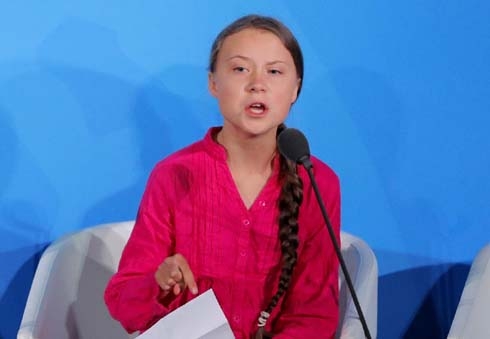
Thunberg was lauded "for inspiring and amplifying political demands for urgent climate action reflecting scientific facts," the Stockholm-based Right Livelihood Award Foundation said.
In August 2018, the 16-year-old began a "school strike" outside the Swedish parliament that inspired a youth-led movement that has staged climate strikes across the globe under the slogan Fridays for Future.
On Monday, Thunberg gave a speech at a UN Climate Action Summit in New York urging world leaders to act to mitgate climate change. "If you choose to fail us, we will never forgive you," she said.
Commenting the award, Thunberg said: "It is not me who is the winner. I am part of a global movement of school children, youth and adults of all ages who have decided to act in defence of our living planet. I share this award with them."
Thunberg was named along with a human rights activist from the Western Sahara region, a lawyer from China, and a leader and association that work for the rights of Brazil's indigenous Yanomami people.
"With the 2019 Right Livelihood Award, we honour four practical visionaries whose leadership has empowered millions of people to defend their inalienable rights and to strive for a liveable future for all on planet Earth," foundation director Ole von Uexkull said.
He added that "Thunberg is the powerful voice [of] a young generation that will have to bear the consequences of today’s political failure to stop climate change."
Aminatou Haidar is the first winner from Western Sahara, the disputed territory claimed by Morocco since 1975.
Haidar has for over 30 years peacefully campaigned for Western Sahara's independence. The jury cited "her steadfast non-violent action, despite imprisonment and torture, in pursuit of justice and self-determination for the people of Western Sahara."
Haidar said the award was "a recognition of my non-violent struggle and the just cause of the Sahrawi people."
Guo Jianmei, a lawyer from China, was lauded for "her pioneering and persistent work in securing women's rights in China."
Guo has helped thousands of disadvantaged people and women get access to justice. She has used the law to protect their rights as well as setting up legal networks offering legal advice free of charge, the award foundation said.
"This award recognizes and acknowledges the efforts of my team and me to uphold women's rights and promote democracy and the rule of law in China, under difficult circumstances for the past 25 years," she said.
Davi Kopenawa, an activist on behalf of Brazil's indigenous Yanomami people, and the Hutukara Yanomami Association were jointly awarded "for their courageous determination to protect the forests and biodiversity of the Amazon, and the lands and culture of its indigenous peoples."
Kopenawa has received death threats over his work to protect the Yanomami, and the award foundation noted that the Amazon rainforests are under threat from illegal logging and wildfires as well as policies pushed by President Jair Bolsonaro's government.
Kopenawa said the award was timely and "a show of trust in me and Hutukara and all those who defend the forest and planet Earth. The award gives me the strength to continue the fight to defend the soul of the Amazon forest."
Each of the four recipients is set to receive a cash prize worth 1 million kronor (103,000 dollars). An award ceremony is set for December 4.
The award foundation said the jury this year considered 142 candidates from 59 different countries.
The award was established to honour issues pertaining to human rights, environmental protection and peace. They were first awarded in 1980, and are not connected to the Nobel Prizes endowed by Swedish industrialist Alfred Nobel.
Past winners include whistleblower Edward Snowden, and Denis Mukwege, a doctor from the Democratic Republic of Congo, for his efforts to assist thousands of rape victims.