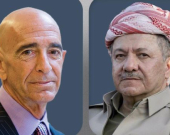
Sen. Ted Cruz: Calls for free and independent Kurdistan
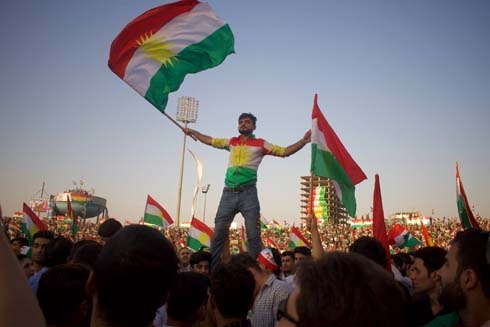
“The Kurds have stood with America over and over again,” Cruz stated. “The Peshmerga have proven to be very effective fighters on the ground, fighting the enemies of America” and “killing the enemies of America so that they’re not killing Americans.”
Cruz also criticized America’s leadership for not reciprocating the Kurds’ repeatedly demonstrated friendship.
“US foreign policy has too frequently failed to stand with the Kurds,” Cruz said. “Their bravery” and “their loyalty” has not been “repaid by the same consistency in US foreign policy.”
“I understand a free and independent Kurdistan drives the Iraqis crazy. It drives the Turks crazy. It doesn’t thrill the Iranians,” he continued.
But “going back to the principle I laid out, our focus on foreign policy” should be “on protecting US national security,” Cruz stated, as he suggested that an independent Kurdistan would do just that: protect US national security.
“The Kurds have bled and fought and died to stand with America,” he emphasized. “I think it is right—not because we’re in the business of promoting democratic utopias—but because our objective should be keeping America safe and standing with those allies who fight with us against our enemies.”
“We should support a free and independent Kurdistan, and I hope that we see it,” Cruz concluded.
The senator’s discussion of the potential role of an independent Kurdistan emerged as he presented a strategic overview of US national security policy on Tuesday at a Hudson Institute seminar, entitled, “Interventionism vs. Isolationism: A Conversation with US Sen. Ted Cruz.”
Interventionism and isolationism represent the two extremes of US foreign policy, and Cruz identified himself as representing the “third point in the triangle.”
Cruz, who has a law degree from Harvard University, served until June 2001, as Associate Deputy Attorney General in the Justice Department under George W. Bush. He then assumed a senior position in the Federal Trade Commission, before going back to Texas in early 2003, after being appointed Solicitor General there. A decade later, in 2013, Cruz returned to Washington, after being elected to the US Senate.
Although Cruz did not mention Bush by name, he was strongly critical of the policy that Bush came to embody. “Interventionism,” Cruz told the Hudson Institute, “is promoting democracy throughout the globe.”
But the “overarching objective of US foreign policy” and the “touchstone for any military involvement should be defending the vital national security interests of the United States,” he said.
“It should not be promoting democracy,” Cruz continued. “It should not be promoting American values. It should be keeping Americans safe.”
This helps explain Cruz’s strong support for “a free and independent Kurdistan.” As he emphasized, the Kurds have repeatedly fought the enemies of America, and they have saved American lives in doing so.
Ronald Reagan is a great hero for Cruz, but as Cruz noted, Reagan was extremely careful about the use of military force. “Reagan was exceptionally reluctant to put our soldiers in harm’s way,” he said.
Rather, Reagan used the presidency as a bully pulpit, articulating a vision that helped bring about the collapse of the Soviet Union and “winning the cold war without firing a shot,” the senator stated.
Cruz also revealed some of his personal history that helps explain his broader strategic thinking. Whereas senior Bush administration officials, including, apparently, Bush himself, came to believe they could transform the Middle East through democracy, Cruz’s family history suggests the implausibility of such a venture.
“My dad grew up in Cuba,” Cruz told the Hudson Institute, and he was “imprisoned and tortured” by the “goons” of Cuban military dictator, Fulgencio Batista. So Cruz’s father “fought in the Cuban revolution,” alongside Fidel Castro, even as he did not know that Castro was a communist.
Once Castro took power in Cuba and declared that he was a communist, “everyone discovered he was even worse than the guy who preceded him,” Cruz said. An aunt, his father’s sister, remained in Cuba and then “fought in the counter-revolution against Castro.”
“She was imprisoned and tortured by Castro’s goons. So my family got it on both sides,” Cruz continued. “That is, sadly, not an unusual story in Latin America. It’s not an unusual story in these countries that have seen tyranny and gone from one tyrant to another.”
It is ironic that Cruz told that story at the Hudson Institute, even as most of those present would probably have been unaware of the irony. Some fifteen years ago, the Hudson Institute was a prominent supporter of Bush’s Middle East democracy agenda.
In early 2005, when Operation Iraqi Freedom was not yet two years old, an Iraqi-American friend returned from Baghdad. He had terrible stories to tell, which showed the war was going even more poorly than the press was reporting at the time.
This reporter arranged for him to address the Hudson Institute, assuming the panel on which he was to speak would deal with the situation in Iraq. However, that was not the case at all.
This was shortly after Bush’s second inaugural address. In soaring language, Bush had proclaimed, “It is the policy of the United States to seek and support the growth of democratic movements and institutions in every nation and culture, with the ultimate goal of ending tyranny in the world.”
So the panel, as it turned out, was all about how democracy was marching through the Middle East, as if Bush’s speech had made it so. Thus, my friend’s warning about the deteriorating situation in Iraq was lost in the celebratory self-congratulation.
It would be another two years before the Bush administration recognized the problem and took action to correct it. But in the meantime, time and lives had been lost.
Editing by Nadia Riva