Robert Mugabe: from liberation hero to toppled dictator
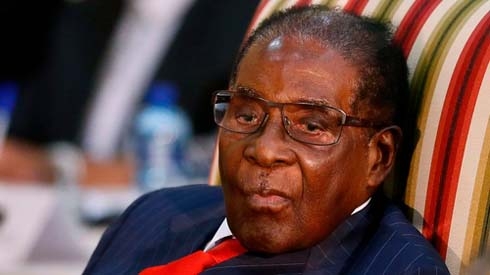
Once an admired intellectual who was a leader in the guerilla war against Rhodesia's white-minority regime, Mugabe's main legacy will be his latter incarnation as a malign autocrat who cracked down on any opposition and whose reckless policies collapsed the economy.
Mugabe "was an icon of liberation, a pan-Africanist who dedicated his life to the emancipation and empowerment of his people," current President Emmerson Mnangagwa tweeted. "His contribution to the history of our nation and continent will never be forgotten. May his soul rest in eternal peace."
Born February 21, 1924, in what was then British-ruled Southern Rhodesia, Mugabe was raised in a Catholic mission and trained as a teacher.
As a young man he joined the National Democratic Party under Joshua Nkomo in its struggle against the government of Rhodesian Prime Minister Ian Smith, who had broken away from Britain in 1965 in an effort to prevent the introduction of black majority rule.
Imprisoned for 10 years from 1964 for his political activities, he accumulated six degrees. He would later boast of also having a degree in violence.
After his release from prison in 1974 he joined and later led the victorious guerrilla war conducted from Mozambique against Smith's breakaway regime.
He rose through the ranks of the rebels to become the head of the Zimbabwe African National Union – Patriotic Front (ZANU–PF), which became Zimbabwe's first ruling party and remains in power.
For his role in liberating Zimbabwe he still enjoys huge respect among many Africans to this day.
At independence in 1980 Mugabe was elected prime minister, moving quickly to extend a hand of friendship to the white minority and making vast strides in improving education and healthcare.
"If yesterday I fought you as an enemy, today you have become a friend and ally with the same national interest, loyalty, rights and duties as myself," he said just hours before independence became official.
"An evil remains an evil whether practised by white against black or by black against white. Our majority rule could easily turn into inhuman rule if we oppressed, persecuted or harassed those who do not look or think like the majority of us," he warned in the speech.
In their eagerness to cast him as a model African leader, Western governments largely ignored early signs of an autocratic tendency.
In the 1980s he deployed North Korean-trained paramilitaries against supporters of the rival Zimbabwe African People's Union (ZAPU) movement in Matabeleland, whom Mugabe accused of fomenting lawlessness.
At least 8,000 members of the Ndebele tribe were killed in the so-called Gukurahundi massacres. Gukurahundi is a Shona word meaning "the early rain which washes away the chaff."
After the death of his first wife Sally from kidney failure in 1992, Mugabe married his much younger former secretary Grace Marufu, with whom he has three children.
The start of his descent into unbridled tyranny is often pegged at his defeat in a referendum on the constitution in 2000 that would have boosted his powers significantly.
Following the defeat, which he blamed on white Zimbabweans' support for the fledgling Movement for Democratic Change (MDC), Mugabe introduced a populist policy aimed at securing his base.
Since independence Mugabe had promised land reform - meant to correct the unequal distribution of the country's wealth, most of which was still white-owned.
He gave the nod for ruling party members and cronies to seize thousands of white-owned farms, decimating commercial agriculture, once the country's biggest foreign exchange earner.
The white-owned commercial farms were the backbone of the country's economy, and the move led to massive inflation - which at one point reached 231,000,000 per cent.
Zimbabwe went from being the breadbasket of southern Africa to having empty supermarket shelves and a 100-trillion Zimbabwe bill couldn't buy a loaf of bread. Millions fled the country, often to neighbouring South Africa, desperate to find work.
Mugabe covered up his own failures not merely with populism, but with
terror, violence, corruption and a personality cult. In the face of setbacks Mugabe's instinct was always to seek revenge.
According to many international observers, Morgan Tsvangirai, the late popular leader of the MDC, won 2008 elections in the first round, but after an onslaught of violence against his supporters ahead of a run-off, withdrew his candidacy.
Tsvangirai, who had been severely tortured by police in 2007 after one of many arrests, later joined a "power-sharing" government with Mugabe in an effort to avoid further violence. He was routinely sidelined and died in early 2018 having never realised his dream of the MDC becoming the governing party.
In his later years, Mugabe was known for his often bizarre comments, once vowing that only God could remove him from office. He also become increasingly fragile and doddery, often seen sleeping in meetings.
As he aged, his wife Grace - widely derided by Zimbabweans as "Gucci Grace" for her extravagant lifestyle - made no secret of her interest in succeeding her husband.
A power struggle between Grace and Mugabe's deputy Emmerson Mnangagwa was ultimately the president's downfall as it resulted in a military coup.
The military forced Mugabe to resign, but remarkably no blood was shed. Humiliated, Mugabe and his wife sunk out of public view, and Mnangagwa took over as president.
Having been hailed for many years as a figure of hope in the
region, Mugabe died a "caricature of an African
dictator," as Archbishop Desmond Tutu of South Africa once described him.