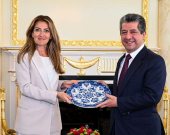
‘Never dull, never quiet in Kurdistan’: UK consul general bids Erbil farewell
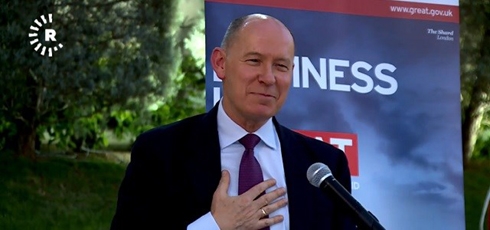
Warr took the helm at the Erbil consulate a matter of weeks before the Kurdistan Region’s independence referendum of September 2017, when overwhelming support for breaking away from federal Iraq prompted Baghdad to impose an embargo on Erbil and seize the disputed territories militarily.
In an unusually candid speech at his leaving reception on Thursday night, Warr shared his personal opposition to the referendum, drawing mock comparisons with Britain’s own 2016 vote to break away from the European Union.
“Referendum. The word and the democratic process that I think should be banned in Kurdistan and the UK,” Warr joked before an audience of dignitaries in the gardens of Erbil’s Rotana Hotel, where the consulate in based.
“That’s a personal view. I’ll just put it out there,” he laughed. “Are Rudaw recording this? Yes they are. Maybe I’ll be leaving sooner than I expected! And not to Brexit Britain, which would be a real plus!”
Warr said the British government had tried unsuccessfully to persuade the Kurdish administration not to hold its referendum for independence. He said the consulate had since played a significant role in mending Erbil-Baghdad relations, but that more work needs to be done.
“We tried to find an alternative to the referendum, but that didn’t work for some reason,” Warr said. “So we then had some pretty unhappy days through October and on for 2017 and 2018.”
“But we’ve spent a lot of time after that rebuilding trust and confidence between Erbil and Baghdad, pushing people from both ends, and I think that has been successful. But there’s still a lot of work to do. And I am sure my successor and all of the team will keep on pushing everybody together to do the right thing,” he added.
'Darkness of Daesh'
Warr came to Kurdistan at the tail end of the conflict to retake territories seized by the Islamic State group (ISIS) across northern Iraq. Hailing the British role in the global coalition assembled to combat the jihadists, he warned the group has not yet been defeated.
“Everybody is very keen to say Daesh has been defeated, or they slip in the word ‘territorially’ defeated,” Warr said, using the Arabic acronym for ISIS. “True or maybe not true. We have clearly had a lot of success countering Daesh, but it is clearly not defeated.”
Reflecting on his time in Kurdistan, the outgoing CG said he has encountered the best and the worst of human nature, from the brutality of ISIS to the fortitude of those displace and persecuted.
“I think it has been a remarkable place at a particularly remarkable time with a lot of very special people,” Warr said, gesturing to his audience.
“There is the darkness of Daesh. I have seen terrible, terrible things committed by humans – so-called humans – against other humans. And they are I’m afraid unforgettable, and they are things that make us do whatever we can to ensure these things never happen again.”
“At the same time, I think I have seen much more of the positive side of the human spirit,” he added.
As a new government takes shape in Erbil and green shoots of economic recovery appear, Warr said he is sad to be leaving just as the Region’s fortunes are beginning to turn.
“I’m particularly sad to be leaving at a time of promise and hope,” he said.
Closing his remarks, Warr said he would miss the Region’s natural beauty and the charm of its people. However, he said working with the Kurds had at times been difficult.
“You are challenging at times. You probably know this,” he said. “But you are above all endearing, charming, and incredibly welcoming. And that is defiantly what I will take back with me.”
“Never dull, never quiet in Kurdistan,” he added.
Diverse government
Speaking to Rudaw following the reception, Warr set out Britain’s goals and priorities for the Kurdistan Region, including gender equality in politics, respect for press freedoms, and the protection of ethnic and religious minorities.
“We are very keen that the new government has as many women ministers and DGs and deputy ministers as possible, because we all know a more diverse government is a better government,” he told Rudaw.
“The second thing is more press freedom, because around the world the media, which is an essential part of a good, modern, healthy society, around the world it is getting persecuted a little bit, and we want that to stop so there is greater freedom of speech everywhere around the world, including in Kurdistan.”
“And finally our foreign secretary is particularly keen on ensuring that the minority communities within Iraq and other places around the world are protected – more protected than they have been in the past,” he said.
Warr will be succeeded by Ambassador James Thornton, who confirmed his appointment to the Erbil mission via social media on Tuesday night.
Thornton has been part of the British Foreign and Commonwealth Office since 1989. Primarily serving in Latin America, he was Ambassador to Bolivia from 2016 until February this year.
The UK has been a crucial partner of the US-led coalition against ISIS. Its military has trained and sought to reform the Kurdistan Region’s Peshmerga forces. Professional and student exchange programs between London and Erbil have also served both nations.
Several high-level leaders in the Kurdistan Region and Iraq were educated or lived in the UK during the time of Baath regime.
Direct flights between the Kurdistan Region and London via British Airways have also been considered amid increased security and stability in Iraq.
Rudaw