Artemis II Astronauts Share Emotional First Press Conference After Historic Lunar Flyby
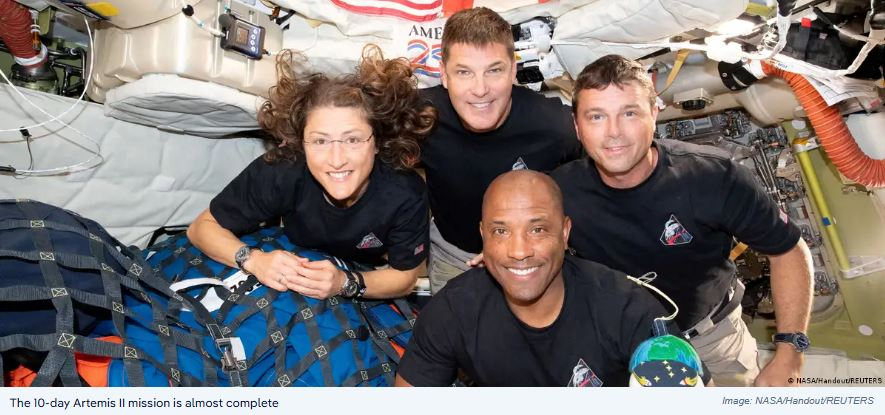
The four astronauts aboard the Artemis II mission have spoken to the press from space for the first time after completing a historic journey around the Moon. The crew, traveling in the Orion spacecraft, reached a record distance from Earth and became the first humans to directly observe the far side of the Moon in decades.
The astronauts—commander Reid Wiseman, pilot Victor Glover, and mission specialists Christina Koch and Jeremy Hansen—shared their emotional reactions as they prepare to return to Earth.
Speaking during the press conference, Wiseman said the experience of traveling so far into space had been overwhelming.
“Human minds should not go through what these just went through,” he said, explaining that the crew still needs time to fully process the experience.
Wiseman described witnessing a solar eclipse from space as particularly powerful. “I’m actually in chills right now just thinking about it—my palms are sweating,” he said.
Mission specialist Hansen, the mission’s Canadian astronaut, said flying around the Moon’s far side revealed sights he had “never even imagined.” From that distance, he reflected on the fragility of Earth.
“We live on a fragile planet in the vacuum and the void of space.”
On Monday, the spacecraft reached approximately 252,000 miles (400,000 kilometers) from Earth, breaking a distance record previously held for 56 years by the crew of the Apollo 13.
Pilot Victor Glover said the crew is still absorbing the magnitude of the mission while preparing for the dangerous reentry phase.
“There’s so many more pictures, so many more stories… and riding a fireball through the atmosphere is profound as well.”
During reentry, the Orion spacecraft will reach speeds of 23,839 mph (38,365 km/h) while enduring extreme heat caused by atmospheric friction.
Mission specialist Christina Koch highlighted the strong bond formed among the crew during the mission. Koch, who previously set the record for the longest single spaceflight by a woman at 328 days, said the team developed a powerful sense of camaraderie while working together hundreds of thousands of miles from Earth.
She emphasized that pushing the boundaries of exploration inevitably involves discomfort and risk.
“We can’t explore deeper unless we are doing a few things that are inconvenient… unless we’re taking a few risks.”
The Artemis II mission, led by NASA as part of the broader Artemis program, marks a major step toward returning astronauts to the Moon by 2028. The program ultimately aims to establish a permanent lunar presence and prepare for future human missions to Mars.
The Orion capsule is expected to reenter Earth’s atmosphere and splash down in the Pacific Ocean off the California coast on Friday, concluding one of the most ambitious human space missions in recent history.